

The Core Philosophy
Ancestral Wisdom, Creative Expression, and the Practice of Reconnection
ORA begins with the understanding that your wellbeing is connected to your relationships with yourself, others, ancestry, culture, nature, and spirit.
Family expectations, inherited beliefs, colonial conditioning, and exclusion can shape what we learn to silence or reject within ourselves.
ORA offers space to explore these influences and cultivate trust in your own knowing.
Rooted in distinct KNOWLEDGE SYSTEMS
The African Philosophies
that Inform ORA
Each contributes to ORA’s approach to relationship, responsibility, and restoration.
-
In Igbo mysticism, Òrà’ refers to the luminous energy field or light radiating from a person's core when living in a state of alignment.
This light is understood as the radiance of a healthy auric field, indicative of alignment within our Chi (Highest self), the earth (Ala), Community (Oha), and the consort of ancestral and spiritual guides (Ezumezu Mmuo) that walk our path with us.ORA as a practice invites awareness of what may dim that light, supporting a return to balance and alignment as part of healing the soul.
-
Rooted in Southern African traditions, Ubuntu is often expressed as “I am because we are.” It recognizes that our humanity and sense of self are shaped through interconnected relationships with family (both living and transitioned), community, and nature.
Within ORA, this philosophy informs communal spaces grounded in empathy, mutual care, and collective wellbeing, where we can witness and be witnessed with dignity.
It also invites us to explore how our relationships shape who we believe ourselves to be and how we experience belonging.
-
The work of Kimbwandènde Kia Bunseki Fu-Kiau, particularly Self-Healing Power and Therapy, is another philosophical influence.
His work highlights how the Dikenga cosmogram (a quartered circle or cross tracking the four moments of the sun) functions as a psychological, physical, and cosmic map for alignment.
In the Kongo worldview, healing is the act of bringing a person who has slipped "outside the circle" back into the center of the communal and cosmic fire.
ORA uses this understanding to guide you through all 4 solar movements to restore Ngolo (vital life force) and Kalûnga (balance between your physical existence and your spiritual/ancestral subconscious). -
In Kemetic philosophy and as proposed by Dr. Wade W. Nobles’ work in African-centered psychology, Sakhu Sheti represents the deep study, purification, and mastery of the self to awaken one's higher divine nature. The philosophy approaches self-understanding through the study and illumination of the human spirit.
Sakhu Sheti cannot occur in a vacuum; its structural foundation is Ma'at (the cosmic law of balance, truth, and universal order). To heal the spirit, a person must align their actions with cosmic rhythm.
This informs ORA’s attention to understanding the expression of spirit, by supporting people in questioning imposed definitions of themselves and reclaiming their own sense of humanity, meaning, and possibility.
From understanding to experience
Why Expressive
Arts and Ritual?
A philosophy becomes meaningful when we can experience and practice it.
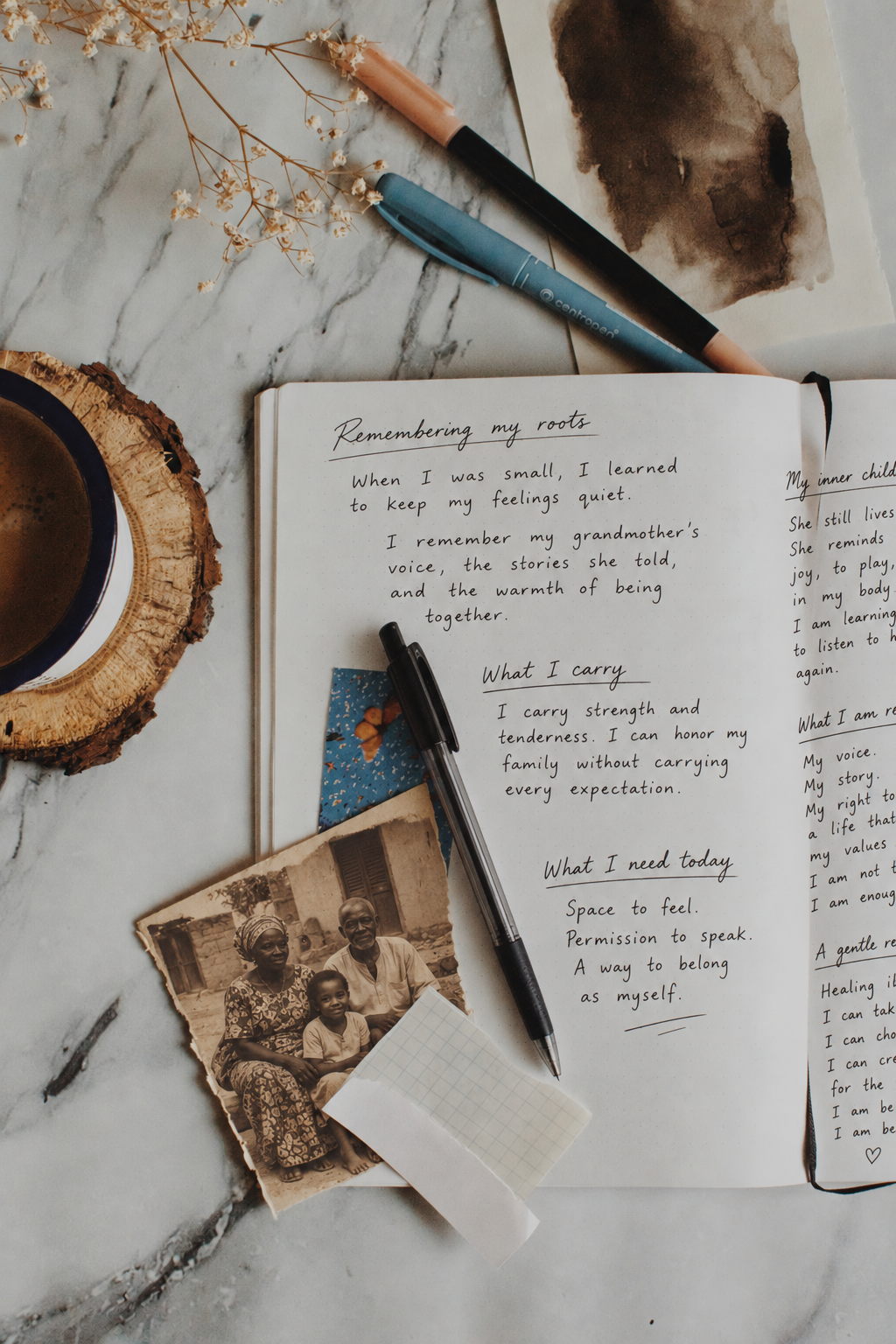
Writing, imagery, movement and storytelling offer ways to explore experiences that may be difficult to explain through conversation alone. Giving a feeling or belief a form creates something you can observe, question, and relate to differently. Artistic skill is unnecessary.
Ritual brings intention and structure to this exploration. A meaningful action can acknowledge a loss, honor a connection, or express a commitment. Practices are invitations shaped by your beliefs, cultural relationships, and comfort.
Together, expression and ritual connect your reflection with action, helping you unravel disconnections and identify everyday choices that better reflect your values.
Evidence and understanding
What Research
Helps Us Understand
These offer insight into the value of the practices informing ORA, rather than proving specific outcomes for the ORA approach.
Ritual and connection
Research on ritual examines how structured, meaningful actions can support emotional regulation and social connection.
Arts and wellbeing
A World Health Organization review of more than 3,000 studies identified a substantial role for arts engagement in supporting health and wellbeing across varied settings and approaches.
Context is part of the work
Why a decolonized
approach matters
Decolonial scholars challenge approaches that locate distress primarily within the individual while overlooking histories of racism, displacement, cultural suppression, and ongoing inequality. When these conditions go unrecognized, responses to harm can be treated as personal dysfunction.
ORA takes the position that healing colonial harm requires us to question the assumptions that helped create it. A diagnosis can help name patterns of distress, but cannot tell the whole story of your relationship with culture, ancestry, spirit, and belonging.
ORA offers a complementary space to explore these relationships, honor your ways of knowing, and reclaim greater authority over how you understand yourself.
ThE philosophy APPLIED TO your life
A More Rooted Relationship
With Yourself
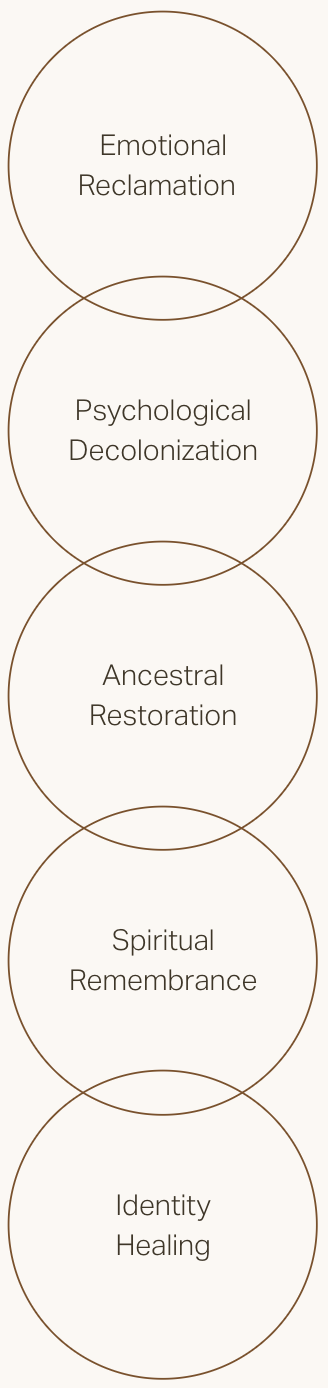
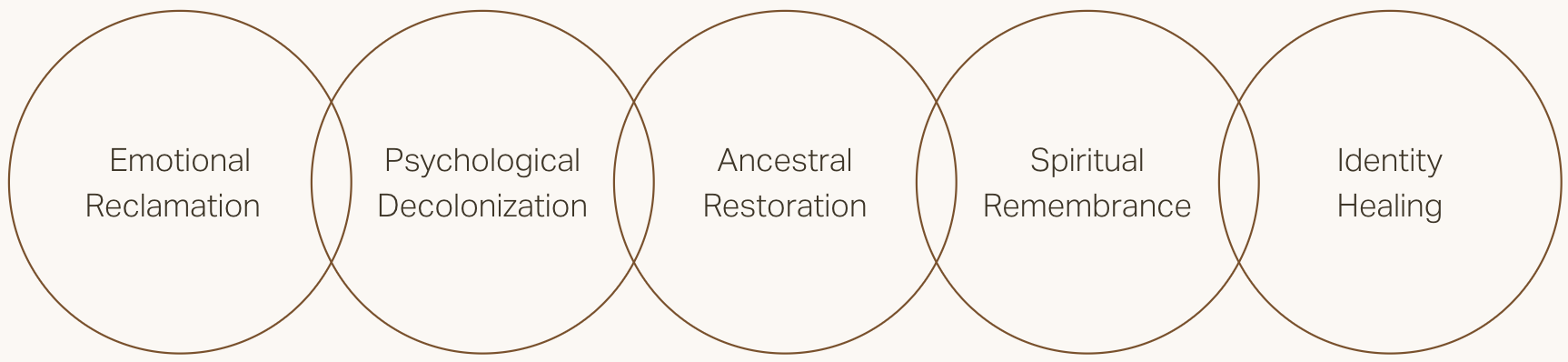
ORA’s five pillars offer gateways to recognize patterns, reconnect with neglected parts of yourself, and practice choices that reflect your own values. My role is to witness, invite, and support that process, while honoring your pace and authority over your experience.
A reading path of your own
Continue Your
Exploration
Explore these books and resources to deepen your understanding of African-centered healing, ancestral connection, decolonization, and creative expression. Begin with what speaks to your own questions and experience.
-
Wade W. Nobles
A deeper foundation for African-centered psychology, cultural consciousness, and the illumination of the human spirit.
Self-Healing Power and Therapy ↗
by Kimbwandènde Kia Bunseki Fu-Kiau
Bantu-Kongo teachings on healing and a philosophical foundation for restoration.
-
The Healing Wisdom of Africa ↗by Malidoma Patrice Somé
Dagara perspectives on ritual, nature, community, and ancestral relationships.
by Jennifer Mullan
Emotional distress, historical trauma, and systems of oppression. Written primarily for practitioners and helpers.
-
by Pat B. Allen
An accessible introduction to creative practice for self-understanding and spiritual exploration.
by Shaun McNiff
Image-making, imagination, and reflective dialogue as ways to engage with inner experience.
-
Igbo Indigenous spirituality and Afa teachings. Some materials require paid access.
Ancestral Voices ↗Documentaries, books, and courses exploring African spiritual philosophies, ancestral wisdom, and Indigenous practices across Africa and the diaspora.